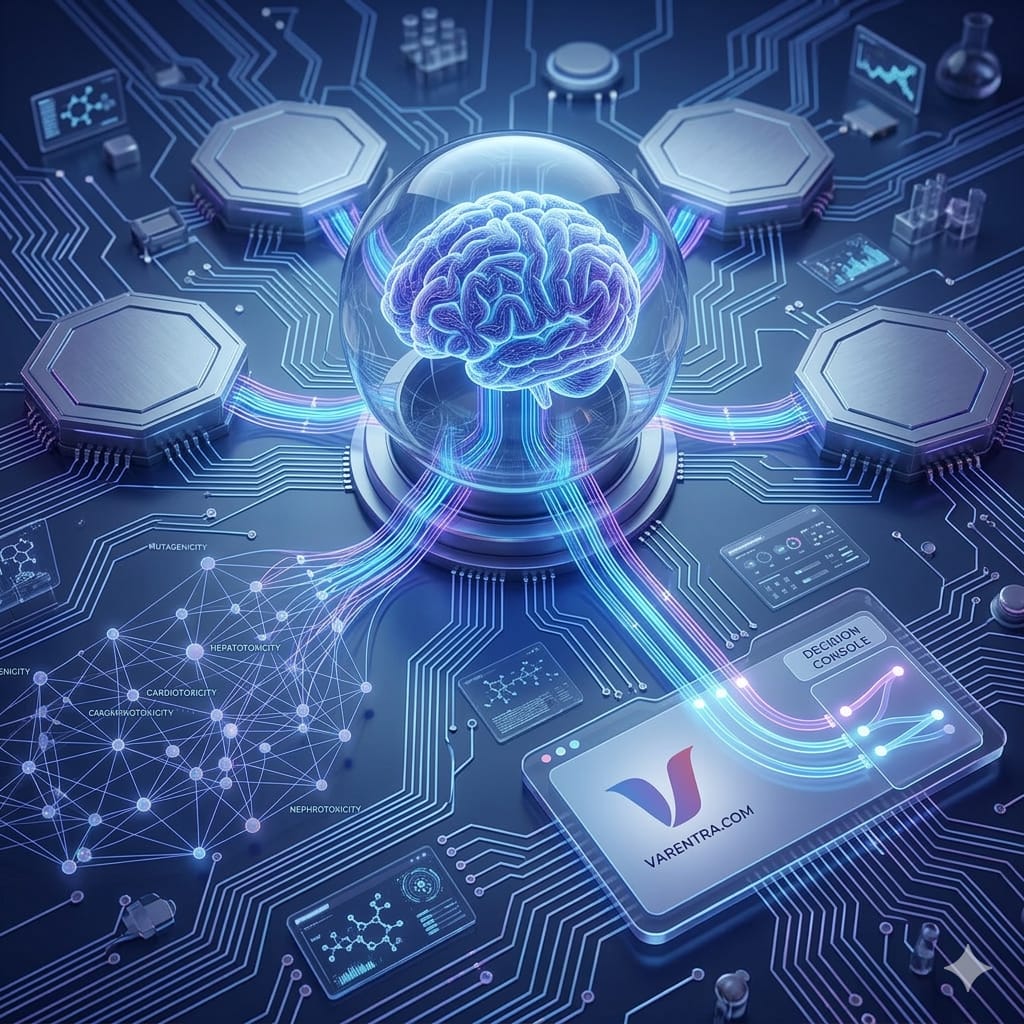
Drug discovery is a long, expensive, and risky journey — with toxicity being one of the biggest reasons why promising drug candidates fail.
Traditionally, predicting toxicity required years of laboratory testing, animal studies, and clinical trials, often costing millions before a single approval.
Today, Artificial Intelligence (AI) is changing that reality. By learning from vast chemical datasets, AI models can now predict the potential toxic effects of molecules before they enter a lab — saving time, money, and lives.
Why Toxicity Prediction Matters
Toxicity prediction lies at the heart of drug safety. Even if a molecule shows high efficacy, it’s useless — and dangerous — if it harms the body.
Common forms of drug toxicity include:
- Hepatotoxicity (liver damage)
- Cardiotoxicity (heart damage)
- Genotoxicity (DNA mutations)
- Neurotoxicity (nervous system damage)
- Carcinogenicity (cancer-causing potential)
AI systems can detect these risks early by analyzing chemical structures and comparing them to known patterns of toxic compounds — something humans alone can’t scale to millions of molecules.
The Traditional Approach: Slow and Costly
Traditionally, toxicity is assessed through:
- In vitro testing (cell-based experiments)
- In vivo testing (animal studies)
- Clinical safety trials
While effective, these methods are:
- Time-consuming (months to years)
- Costly (millions per compound)
- Ethically challenging (animal testing)
- Poorly scalable (limited by lab throughput)
This is where AI comes in — bringing computational precision and scale to toxicity screening.
The AI Revolution in Toxicity Prediction
Traditional toxicity testing is slow, expensive, and limited. Evaluating a single molecule in the lab can take weeks or even months. Today, AI has completely reshaped this process — enabling toxicity prediction at a scale that was impossible just a few years ago.
Our platform leverages cutting-edge deep learning and graph-based neural architectures capable of understanding chemical structures at an atomic level. Rather than relying on manually engineered rules, our models learn toxicity behavior directly from massive real-world biochemical datasets.
What Makes Our Approach Different
Our model is trained on over 100 million+ chemical compounds sourced from leading scientific repositories and internally curated datasets. This enormous training scale allows the model to recognize complex toxicity patterns that smaller datasets could never capture.
How the System Works
Massive Data Foundation
Millions of experimentally validated molecules from datasets such as Tox21, ToxCast, ChEMBL, and private data provide the backbone of our training pipeline.
Advanced Molecular Understanding
Each compound is transformed into formats suitable for the model to understand biology and chemistry, enabling deep representation learning.
State-of-the-Art Model Training
Transformers, graph neural networks, and our proprietary architecture learn the relationships between atomic structure and biological toxicity.
Unmatched Discovery Speed
With AI, toxicity screening that once took months can now be done in hours, allowing rapid filtering of unsafe molecules and dramatically shortening the drug discovery cycle.
From millions to the right molecule — faster than ever before.
Real-World Impact
AI-driven toxicity prediction delivers measurable advantages:
- 🚀 Faster discovery: early toxicity filtering eliminates unpromising molecules upfront.
- 💸 Cost reduction: fewer failed compounds in clinical trials save millions.
- 🧬 Ethical progress: reduced animal testing via in-silico prediction.
- 🔬 Higher accuracy: deep learning captures non-linear chemical relationships missed by rule-based systems.
For example, companies like Insilico Medicine, BenevolentAI, and Atomwise already leverage AI to predict drug safety — demonstrating that predictive toxicology is no longer futuristic; it’s here.
Our Vision: Safer Drugs with Smarter Models
At Varentra, we are advancing this frontier by building AI models that predict molecular toxicity with high accuracy and interpretability. Our systems combine:
- Molecular graph neural networks to capture structural patterns
- Transformer-based encoders to understand SMILES sequences
- Explainable AI (XAI) layers to visualize why a molecule might be toxic
The result? A system that doesn’t just predict if a molecule is toxic — but also why. This helps researchers make informed design choices early in the discovery pipeline, accelerating safe and effective drug development.
The Road Ahead
As AI and computational chemistry converge, the future of drug discovery is shifting from trial-and-error to data-driven precision. Toxicity prediction will continue evolving with:
- Multimodal models combining chemical, genomic, and biological data
- Generative AI that avoids designing toxic molecules in the first place
- Regulatory adoption of AI models for early safety assessments
In this new era, every molecule designed can be screened for safety within seconds — bringing humanity closer to faster, safer, and more ethical drug discovery.
Key Takeaways
- AI is transforming toxicity prediction from a reactive process to a proactive one.
- Deep learning models can identify toxic compounds before lab testing begins.
- This saves time, cost, and lives — while promoting ethical innovation.
- The future of toxicology is computational, interpretable, and scalable.
🚀 At Varentra, we’re building AI models that make drug discovery faster, safer, and smarter. Learn more about our technology → varentra.com